What a Chain Drive Bucket Elevator Is and How It Differs from Belt-Driven Systems
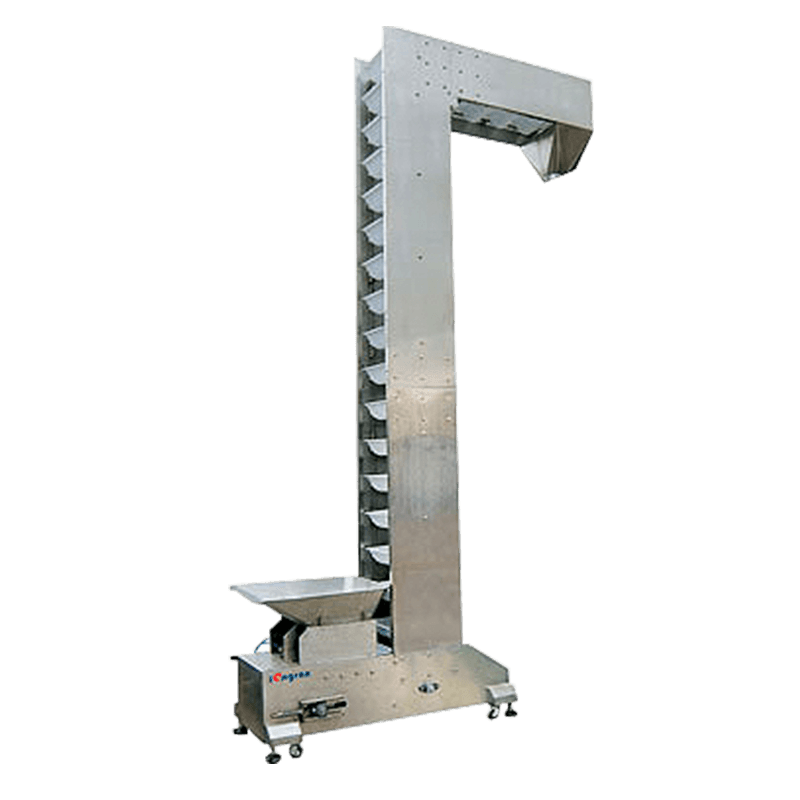
A chain drive bucket elevator is a continuous vertical conveying machine that uses one or two endless chains as the traction element to carry a series of buckets in a continuous loop, lifting bulk materials — grain, cement, fertiliser, coal, minerals, or industrial powders — from a lower loading point to an elevated discharge point. The chain connects to sprockets at the top (head) and bottom (boot) of the elevator, with the drive unit typically located at the head section where the chain and buckets travel over the drive sprocket and the material is discharged by centrifugal force, gravity, or a combination of both into a discharge chute.
The fundamental difference between chain drive and belt drive bucket elevators lies in the traction element and the operating conditions each system suits. Belt elevators use a rubber or fabric conveyor belt to carry the buckets, offering smooth, quiet operation, lower bucket wear on fragile materials, and higher operating speeds — but with limitations on operating temperature, material abrasiveness, and maximum lift height before belt tension becomes problematic. Chain drive bucket elevators, by contrast, use steel chains that can withstand significantly higher temperatures, handle coarse, abrasive, and heavy materials that would rapidly destroy a rubber belt, and operate at lower speeds with higher bucket fill levels — the combination that makes chain elevators the preferred choice for heavy industrial applications including cement manufacturing, mining, steel plant raw material handling, and processing of hot or chemically aggressive bulk solids.
Main Components of a Chain Drive Bucket Elevator
Understanding the function of each major component helps with specification, troubleshooting, and maintenance planning. A chain bucket elevator consists of several interconnected systems that must be correctly matched to each other and to the operating conditions.
Head section and drive assembly
The head section sits at the top of the elevator and houses the drive sprocket, shaft, bearings, and the discharge chute. The drive sprocket meshes with the chain and transmits torque from the drive unit — typically an electric motor connected through a gearbox and sometimes a fluid coupling or variable frequency drive — to pull the loaded chain and buckets upward on the ascending side. The head section also provides the discharge point where material exits the buckets into the outgoing chute. The geometry of the head section — sprocket diameter, hood shape, and discharge chute angle — determines whether discharge occurs primarily by centrifugal throw, gravity, or positive (guided) discharge, each suited to different material types and operating speeds.
Boot section and take-up
The boot section at the base of the elevator houses the tail sprocket, the material loading inlet, and the chain take-up system. Material is fed into the boot either by gravity through an inlet chute (centrifugal loading) or by the buckets scooping material from a pool in the boot (digging loading). The take-up mechanism — typically a screw take-up or gravity take-up — adjusts the tension in the chain by moving the tail shaft position, compensating for chain elongation due to wear and thermal expansion. Maintaining correct chain tension is critical for smooth operation and for preventing chain derailment from the sprockets. The boot section is also the location most susceptible to material build-up and wear, particularly in digging-loaded elevators where the buckets repeatedly impact the material pile during filling.
Casing and enclosure
The elevator casing encloses the chain and bucket assembly along the vertical run between head and boot, containing the material, controlling dust, and providing structural support. Casings are typically fabricated from mild steel plate for standard applications, with stainless steel, abrasion-resistant steel, or special alloy construction available for corrosive, high-temperature, or highly abrasive materials. Casing sections are bolted together in modular lengths — typically 1.5 to 3 metres per section — to allow transport to site and field assembly to the required lift height. Inspection doors at regular intervals along the casing allow visual access to the chain and buckets during operation and facilitate maintenance and blockage clearing. For explosive dust environments — grain handling being the primary example — the casing must be designed and constructed to comply with applicable ATEX or equivalent dust explosion containment or venting standards.
Chains
The chain is the defining element of a chain drive bucket elevator and must be selected for the combination of tensile load, abrasion, temperature, and corrosion conditions of each application. Chain types used in bucket elevators include forged link chain (also called round link or stud link chain), malleable iron chain, cast steel chain, and engineering class roller chain. Forged link chain is the most common in heavy-duty mining and cement applications — the forged steel links offer excellent fatigue resistance and impact toughness. Engineering class roller chain — similar in concept to bicycle or motorcycle chain but in much heavier industrial grades — is used in elevators where precise pitch is important for sprocket engagement and where the lower weight of roller chain compared to forged link is advantageous for high-speed applications. Chain pitch — the centre-to-centre distance between attachment points — must match the bucket spacing and sprocket tooth geometry precisely.
Buckets
Buckets are the carrying elements that scoop, transport, and discharge the material. They are manufactured in a range of materials — mild steel, high-chrome white iron, stainless steel, polyethylene, and nylon — and in several profile geometries suited to different material types and operating speeds. Pressed steel buckets are the standard for medium-duty applications. Cast iron or high-chrome white iron buckets are used for highly abrasive materials such as clinker, sand, and ore. Polyethylene and nylon buckets are used for food-grade, pharmaceutical, and mildly abrasive applications where contamination from metal particles is a concern. Bucket profile — the relationship between bucket width, projection (depth), and back-plate height — is matched to the material's bulk density, lump size, and flowability to achieve efficient filling and clean discharge.
Types of Chain Drive Bucket Elevators and Their Operating Principles
Chain bucket elevators are categorised by their chain configuration, bucket spacing, and discharge method. Each type is optimised for specific material characteristics and capacity requirements.
| Type |
Chain configuration |
Discharge method |
Best suited materials |
Typical application |
| Single chain centrifugal |
One central chain |
Centrifugal throw |
Free-flowing grains, seeds, granules |
Grain handling, fertiliser |
| Double chain centrifugal |
Two side chains |
Centrifugal throw |
Heavier granular materials |
Coal, potash, aggregate |
| Double chain gravity |
Two side chains |
Gravity / positive discharge |
Sticky, lumpy, or fragile materials |
Clinker, slag, large coal lumps |
| Super-capacity / high-capacity |
Two heavy chains, large buckets |
Gravity / positive discharge |
High-density bulk solids |
Cement raw meal, crushed stone, ore |
| Continuous (pendant) bucket |
Two chains, closely spaced buckets |
Positive discharge (bucket tips over next bucket) |
Fragile, sticky, or aerated materials |
Cement, fly ash, alumina, chemicals |
The continuous bucket elevator — where buckets are spaced so closely that the back of the leading bucket acts as a guide surface for material discharging from the trailing bucket — deserves particular attention because its operating principle differs fundamentally from centrifugal discharge types. At the head, instead of throwing material outward by centrifugal force, the buckets pass over the head sprocket and tip forward, discharging material onto the back of the preceding bucket and from there into the discharge chute. This positive discharge mechanism is independent of operating speed, which allows continuous bucket elevators to run at lower speeds than centrifugal types — an advantage for fragile materials that would be damaged by the high-speed impact of centrifugal discharge, and for sticky or cohesive materials that do not self-discharge cleanly by centrifugal throw.
Capacity Calculation and Sizing for Chain Bucket Elevators
Sizing a chain drive bucket elevator correctly requires calculating the required volumetric and mass throughput and then selecting a bucket size, bucket spacing, chain speed, and drive power that together deliver that throughput reliably. Under-sizing creates a system bottleneck; over-sizing wastes capital and increases operating cost. The following methodology covers the key sizing steps.
Volumetric capacity calculation
The theoretical volumetric capacity of a bucket elevator is calculated from the bucket volume, the bucket fill factor, the chain speed, and the bucket spacing. The formula is: Q (m³/h) = (V × φ × 3600 × v) / a, where V is the bucket volume in litres, φ is the fill factor (typically 0.6 to 0.85 depending on material flowability and loading method), v is the chain speed in metres per second, and a is the bucket pitch (spacing between bucket attachment points) in metres. Mass throughput is then obtained by multiplying volumetric capacity by the material bulk density. For materials with high bulk density — such as iron ore at 2.0 to 2.5 t/m³ — the chain and bucket must be selected for the resulting high mass load per linear metre of chain, not just the volumetric throughput.
Chain speed selection
Chain speed in bucket elevators is substantially lower than belt speed in equivalent belt elevators, reflecting the heavier chain mass and the need to avoid excessive centrifugal forces on the chain at sprocket contact. Typical chain speeds range from 0.4 to 1.0 m/s for heavy-duty double chain gravity discharge elevators, rising to 1.0 to 1.8 m/s for centrifugal discharge types, and rarely exceeding 2.0 m/s for any chain elevator application. Higher chain speeds increase capacity for a given bucket volume and spacing but also increase chain wear, sprocket wear, and the impact loading on chain links as buckets enter the boot section. For materials that are abrasive, lumpy, or temperature-sensitive, conservative chain speed selection extends service life significantly.
Drive power calculation
The drive power required for a chain bucket elevator is the sum of the power needed to lift the material (the useful work component) and the power consumed by chain friction, bucket air resistance, and drive train losses. The lifting power is: P_lift (kW) = (Q × H × g) / (3600 × η), where Q is mass throughput in t/h, H is lift height in metres, g is gravitational acceleration (9.81 m/s²), and η is overall drive efficiency (typically 0.85 to 0.92 for gearbox and chain drive losses combined). Total installed motor power includes a service factor of 1.25 to 1.5 above the calculated requirement to accommodate start-up loads, occasional overloads, and the additional chain friction that develops as the chain wears and elongates over its service life.
Material Compatibility and Application-Specific Considerations
Chain drive bucket elevators handle a wider range of difficult materials than belt elevators, but not every material is equally straightforward to handle. The following material characteristics have specific implications for elevator design and component selection.
- High temperature materials: Materials above 100°C — including cement clinker at 80 to 150°C, calcined alumina, or hot ash — require heat-resistant chain construction with alloy steel links, high-temperature lubricants in chain links and bearings, and steel buckets rather than plastic. Casing expansion joints must accommodate thermal growth of the structure. Standard roller chain with polymer seals is unsuitable above approximately 80°C; forged link chain or high-temperature roller chain is required for sustained elevated temperature operation.
- Highly abrasive materials: Quartzite, silica sand, clinker, and iron ore impose severe wear on bucket lips, bucket backs, and the chain links that contact the boot trough. High-chrome white iron or hardox steel buckets with replaceable wear lips extend service life significantly in these applications. The boot section trough and the areas where chain contacts the casing must be lined with wear-resistant steel or ceramic tiles. Monitoring chain elongation monthly and replacing chain before it elongates beyond 2 to 3% of original pitch length prevents sprocket tooth jumping that causes sudden chain derailment.
- Sticky and cohesive materials: Wet clay, moist coal, or adhesive chemicals can adhere to bucket surfaces and fail to discharge cleanly at the head, building up over time and causing imbalance, blockage, and eventual mechanical failure. Positive discharge (continuous bucket) elevator types minimise this problem compared to centrifugal discharge. Bucket surface treatment — smooth finish, PTFE coating, or polyethylene bucket lining — reduces adhesion. Some installations use vibrators on the head section to assist material release from sticky materials.
- Explosive or combustible dust materials: Grain, flour, sugar, coal dust, and many chemical powders form explosive dust-air mixtures within elevator casings under normal operating conditions. Chain bucket elevators handling these materials must be designed to ATEX Zone 21 or equivalent standards — explosion venting panels on the casing at regular intervals, anti-static chain and buckets, earthing of all metallic components, and speed monitoring to detect belt or chain slip that could generate ignition-level heat from friction. Grain elevator explosions have caused multiple fatalities historically, and compliance with applicable dust explosion regulations is a non-negotiable requirement for these applications.
- Corrosive materials: Fertilisers containing ammonium nitrate or potassium chloride, chemical powders, or materials in humid coastal environments can cause rapid corrosion of mild steel chain and casing components. Stainless steel chain, stainless steel casing construction, or protective coatings with regular inspection and replacement schedules are required. Galvanised chain provides limited protection — in aggressive chemical environments, the zinc coating depletes rapidly, and stainless steel is a more durable solution despite its higher initial cost.
Chain Selection and Tensile Load Management
The chain is the most critical and most failure-prone component in a chain drive bucket elevator. Correct chain selection and tensile load management are the most important technical decisions in elevator design.
The maximum chain tension occurs on the ascending loaded side at the head sprocket, and is the sum of the weight of the loaded chain and buckets on the ascending side plus the tension required to pull the empty chain and buckets on the descending side against gravity and friction. For a double chain elevator, the total tension is shared equally between the two chains, so the working tension per chain is half the total calculated tension. The selected chain must have a minimum breaking load (MBL) significantly above the calculated working tension — a minimum safety factor of 7:1 against MBL is conventional for bucket elevator chains in continuous operation, rising to 10:1 for applications with severe shock loading from large lump materials or frequent starts against full load.
Chain fatigue — the progressive weakening of chain links under repeated cyclic loading — is the primary failure mode in well-maintained elevator chains rather than static overload. The fatigue life of a chain is strongly dependent on the ratio of working tension to MBL — chains operated at lower fractions of their MBL last disproportionately longer than chains pushed closer to their rated capacity. Selecting the next chain size above the minimum required by calculation is frequently justified on lifecycle cost grounds, as the incremental cost of heavier chain is small relative to the cost of unplanned downtime for chain replacement.
Maintenance Practices That Determine Chain Elevator Reliability
A chain drive bucket elevator is a mechanically straightforward machine, but one that degrades rapidly if maintenance is neglected. The following maintenance practices have the greatest impact on service life and availability.
- Chain elongation monitoring: Measure chain pitch at multiple points around the loop every three to six months (more frequently in abrasive applications) using a chain wear gauge or by measuring the length of a ten-link section and comparing against the new chain nominal dimension. Replace chain when elongation reaches 2% of original pitch length — at this point, the chain will no longer mesh correctly with the sprocket teeth, causing accelerated sprocket wear and risk of chain jumping. Replacing chain before this threshold is reached is significantly cheaper than replacing chain and worn sprockets together.
- Chain lubrication: Chain links require lubrication to reduce pin and bushing wear. In many bucket elevator applications, automatic chain lubrication systems that apply a metered quantity of lubricant to the chain pins as the chain passes a lubrication point provide more consistent and reliable lubrication than manual oiling. The lubricant specification must be compatible with the material being handled — food-grade lubricant is required for food and pharmaceutical applications, and some chemical applications require lubricants resistant to specific solvents or corrosives.
- Bucket inspection and replacement: Inspect bucket lips, backs, and attachment bolt holes monthly. Worn bucket lips reduce fill efficiency and allow material to fall back through the clearance between bucket and casing. Cracked or broken buckets must be replaced immediately — a bucket fragment released in the elevator casing can jam between the chain and sprocket, causing sudden chain failure or casing damage. Bolted bucket attachments should be checked for correct torque at each scheduled inspection, as vibration progressively loosens fasteners.
- Take-up adjustment: Inspect chain sag in the boot section and adjust the take-up to maintain the correct chain tension monthly. Insufficient tension causes chain sag that can contact the casing or cause chain de-tracking from the sprockets. Excessive tension accelerates chain, sprocket, and bearing wear and increases drive power consumption. Record take-up position at each adjustment — a trend of increasing take-up extension indicates chain elongation and helps predict when chain replacement will be required.
- Boot section cleanout: Material build-up in the boot section — inevitable in most applications — raises the level at which buckets begin their digging action, increasing scooping resistance and chain tension. Regular boot cleanout, either through scheduled manual cleaning or automatic boot level control systems, maintains consistent loading conditions and reduces the risk of boot-level surges that overload the drive system.
What to Evaluate When Specifying or Purchasing a Chain Drive Bucket Elevator
Purchasing a chain drive bucket elevator is a significant capital investment, and the operational performance and total cost of ownership depend heavily on how well the specification matches the actual application requirements. The following evaluation framework covers the key questions to resolve before committing to a supplier or design.
- Has the material been fully characterised? Provide the supplier with complete material data — bulk density (loose and compacted), lump size distribution, moisture content range, temperature range, abrasiveness (Bond Work Index or Mohs hardness for abrasive assessment), angle of repose, and any chemical properties relevant to material compatibility. Incomplete material characterisation is the most common cause of elevator underperformance and premature wear. If the material varies seasonally or with source, specify the worst-case conditions rather than average conditions.
- What is the required capacity and how was it calculated? Confirm whether the stated capacity requirement is a peak duty (maximum instantaneous throughput) or an average throughput. Design to the peak duty with a service factor. Verify that the supplier's capacity calculation uses the correct bulk density and fill factor for your specific material — generic fill factors for "similar" materials can produce significant errors in actual throughput for cohesive or variable materials.
- What chain safety factor is being applied? Request the supplier's chain selection calculations showing working tension, chain MBL, and the resulting safety factor. A minimum safety factor of 7:1 against MBL is appropriate for continuous operation; less than this should be queried and justified. Confirm that the safety factor accounts for dynamic loads from startup against full load, not just steady-state running tension.
- What access and maintenance provisions are included? Confirm the number and location of inspection doors, the access arrangement for the head and boot sections, the chain take-up adjustment method and access point, and whether the drive arrangement allows maintenance without disturbing the chain or casing. Elevators that are difficult to inspect and maintain will not be maintained properly, leading to premature failure and unplanned downtime.
- What safety systems are included as standard? As a minimum, confirm that the elevator includes a backstop device (to prevent reverse rotation and chain runback under load on power failure), a speed monitor (to detect chain slip, breakage, or blockage), and overload protection on the drive motor. For explosive dust applications, confirm ATEX compliance documentation and the design basis for explosion protection.
- Are spare parts held in stock? Confirm that the supplier or a regional distributor holds stock of the critical wear parts — chain (including matched replacement lengths), bucket sets, and sprockets — for the specific elevator model and size you are purchasing. An elevator that cannot be returned to service within 24 to 48 hours of a chain or bucket failure due to parts unavailability has an unacceptable operational risk profile for most production-critical applications.


 English
 Español
 عربى
عربى


Contact Us