Material conveying is one of those parts of a packaging line that rarely gets attention until it stops working. When product hangs up in a hopper, dust escapes at a transfer point, or a vertical lift becomes the bottleneck before the filling machine, the whole line feels it. We have seen enough of these moments to know that the best material conveying solutions are usually the quiet ones: steady, well matched to the material, and easy for operators to live with.
This guide is written for production teams, project engineers, and maintenance managers who need to move granules, powders, or liquids from receiving and storage into the packaging process without creating new problems downstream. It is not about buying the biggest conveyor on the market. It is about choosing a conveying approach that fits the material, the building, the hygiene standard, and the people who will clean and maintain it.
What Material Conveying Solutions Include
Material conveying covers much more than a single conveyor belt. Depending on the product and plant layout, it can include mechanical equipment such as bucket elevators, belt conveyors, screw conveyors, and vibratory feeders, or pneumatic systems that use air to move powders and granules through pipes. Each option has a place. The useful question is not “Which conveyor is best?” but “Which transfer method suits this material, this distance, and this level of hygiene?”
In packaging environments, conveying usually sits between bulk intake and the packaging machine hopper. It may also connect mixing, screening, metal detection, weighing, and secondary packaging. A good solution considers every transfer point, because every change in direction or elevation is a place where material can build up, break down, or create dust.
Common conveying options and where they tend to fit in packaging and processing lines.
| Option |
Typical role |
Strengths |
Watch-outs |
| Bucket elevator |
Vertical lifting of granules and powders to a higher floor or hopper |
Compact footprint, good for controlled vertical transfer, familiar to maintenance teams |
Needs correct bucket spacing, cleanout access, and dust control at discharge |
| Belt conveyor |
Gentle horizontal or inclined movement of packaged or bulk items |
Simple layout, easy visual inspection, flexible length |
Material spillage and carryover need attention; not ideal for fine dusty powders |
| Screw conveyor |
Short-distance transfer of powders and small granules |
Enclosed design, steady feed, compact installation |
Can damage fragile products; sticky or caking materials may clog |
| Pneumatic conveying |
Dust-free transfer through pipes over longer or complex routes |
Good containment and layout flexibility |
Needs careful air and product testing; energy use and wear vary by material |
The table is only a starting point. A material that flows well in one plant may behave differently in another because of humidity, temperature, particle size, or the age of the product. That is why conveying decisions should be based on samples and operating conditions, not catalogue descriptions alone.
Start With the Material, Not the Machine
Before discussing motors, angles, or throughput, we ask what the product actually does. Free-flowing salt and fine milk powder do not behave the same way. Neither does a sticky chemical blend and a fragile snack pellet. Bulk density affects capacity. Particle shape affects wear. Moisture affects adhesion. Dust affects safety and housekeeping. A conveyor that looks correct on paper can fail quickly if the material packs, cakes, or smears inside the transfer chute.
Questions worth asking early
- How does the material flow when it is poured, pressed, or left at rest?
- Is it abrasive, fragile, sticky, hygroscopic, or prone to static build-up?
- What is the bulk density, particle size range, and typical moisture content?
- Will the material change with temperature, humidity, or seasonal storage?
- Is dust explosive, toxic, or simply a housekeeping nuisance?
- Does the process require frequent cleaning, product changeover, or washdown?
Small-scale tests are often more useful than assumptions. A sample check can reveal whether a bucket elevator will discharge cleanly, whether a screw will smear a soft product, or whether a pneumatic line will need a different air velocity. If the material is known to pack or cake, design the system with access, slope, and cleanout in mind from the beginning. Those details are much cheaper to plan than to retrofit.
Match the Conveyor to the Plant Layout
Layout is where conveying projects either become elegant or become a maintenance headache. Distance matters, but so do headroom, floor loading, support structures, transfer points, and the space needed for future service. A short horizontal run may be simple, while a vertical lift may solve a space problem but introduce discharge and dust-control requirements. Our material conveying systems are organized around these practical constraints rather than a one-size-fits-all machine list.
Vertical lifting deserves particular attention because it often feeds the packaging machine directly. If the lift is undersized or poorly controlled, downstream weighing and filling become inconsistent. The discharge point should be designed to avoid segregation, and the feed should be steady enough to prevent slugs of product from overwhelming the hopper.
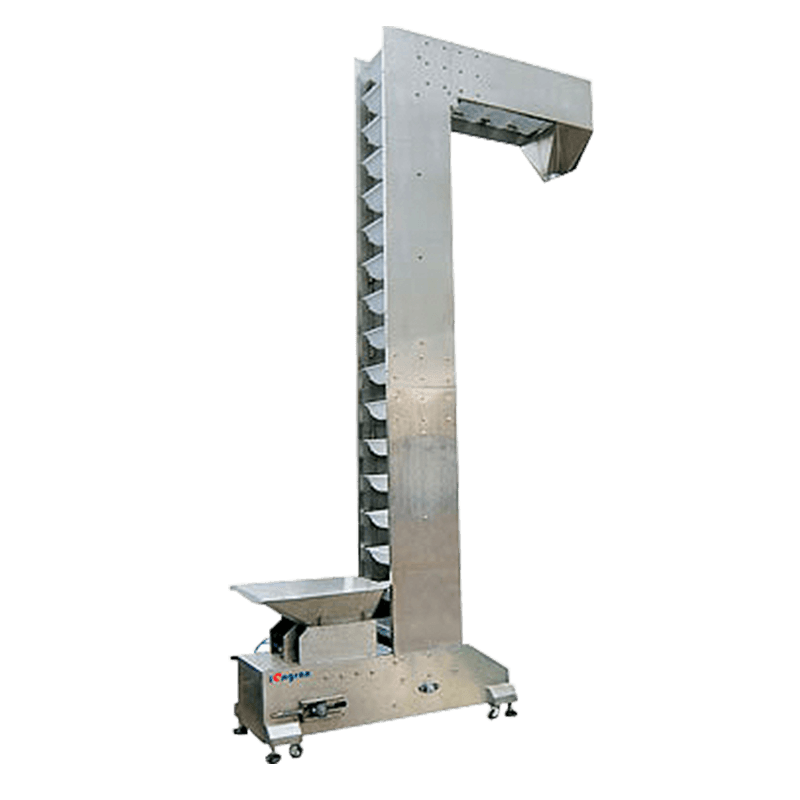 DT-5 Chain Drive Bucket Elevator for Vertical Material HandlingA stainless steel chain-drive elevator for small blocks, pellets, and granules; 3–6 m lift height and 1.5 m³/h capacity suit food, feed, and chemical handling.View Product →
For plants that need a reliable vertical link between bulk intake and packaging, a chain-drive bucket elevator is a familiar and practical choice. The key is to size it for the real material and the real operating rhythm, not just the nominal tonnage. A buffer hopper, level sensor, and well-placed inspection door often make more difference to daily uptime than a small increase in motor power.
Hygiene, Safety, and Maintenance
In food, pharmaceutical, and chemical production, conveying equipment must be judged by how well it can be kept clean and how safely it handles dust. Smooth surfaces, stainless steel where required, removable guards, and good access for inspection all matter. So do grounding, dust extraction, and correctly rated components in areas where fine powders are present. A conveyor that is difficult to clean will eventually be cleaned poorly, and that is a quality risk.
Practical checks for sensitive environments
- Can operators see and reach the main transfer points without dismantling the line?
- Are there ledges, dead corners, or sharp steps where product can accumulate?
- Are motors, sensors, and bearings protected from dust and washdown as needed?
- Are guards and emergency stops accessible, and are nip points properly covered?
- Is there a realistic cleaning routine that does not require removing half the conveyor?
Maintenance should be planned into the design as well. Belt tension, bucket alignment, chain lubrication, bearing condition, and discharge wear are easier to manage when the equipment has inspection points and a clear service manual. Spare parts should be standard and available, especially for high-wear items. The best time to discuss this is before the order, not during a shutdown.
Integrate Conveying With Packaging and Quality Control
Conveying does not end at the hopper. The way material arrives affects weighing accuracy, filling speed, dust levels, and even the performance of checkweighers and metal detectors further downstream. A steady, controlled feed is usually better than a fast but uneven one. If the packaging machine is expected to run at high speed, the conveyor upstream must be able to sustain that rate without starving or flooding the feed system.
- Confirm the conveying rate matches the packaging machine’s real demand, including start-up and changeover.
- Check that transfer points minimize breakage, segregation, and dust generation.
- Provide level sensing and interlocking so the conveyor stops before a hopper overfills.
- Plan access for cleaning and inspection without isolating the entire production area.
- Review how rejected or sampled material will be handled without disrupting the main flow.
For teams reviewing vertical transport options, this bucket elevator guide offers a useful technical overview. The broader point is that conveying, filling, weighing, and inspection should be commissioned as one system. Small adjustments to feed control often improve the whole line more than isolated equipment upgrades.
Common Pitfalls to Avoid
- Choosing capacity from a product catalogue without testing the actual material.
- Ignoring cleanout access until the first product changeover.
- Forgetting that dust control is part of conveying design, not an afterthought.
- Undersizing discharge points and hopper transitions, which creates surging and blockage.
- Treating the conveyor as a standalone machine rather than part of the packaging line.
Choosing material conveying solutions is ultimately a process of matching. Match the equipment to the material, the layout, the hygiene standard, and the maintenance team who will keep it running. When those pieces align, conveying becomes what it should be: a dependable link between storage and packaging, with fewer surprises, less dust, and more consistent production. That is the kind of quiet performance we aim for in every conveying project.


 English
 Español
 عربى


Contact Us