Choosing the wrong liquid filling machine is one of the most expensive mistakes a manufacturer can make — not just in upfront cost, but in downtime, rework, and product waste that accumulates every shift. The right machine depends on what you're filling, how fast you need to fill it, what containers you're using, and how much you expect production to grow. This guide covers every major type of liquid filling machine, how each one works, what it's best suited for, and what specifications actually matter when you're comparing options.
How Liquid Filling Machines Work: The Core Principles
Every liquid filling machine — whether it's a simple benchtop unit or a fully automated inline system — is built around one of two fundamental filling principles: volumetric filling or level filling. Understanding the difference between them is the starting point for every other decision.
Volumetric filling dispenses a precise, predetermined amount of liquid by volume into each container, regardless of the container's internal dimensions. It's the right approach when fill weight or volume compliance is critical — pharmaceuticals, food products sold by volume, and chemical products all require volumetric accuracy. Piston fillers, pump fillers, and gravity timed-flow fillers all operate on volumetric principles.
Level filling fills each container to a specific visual level rather than a fixed volume. This is the approach used by overflow filling machines. It's ideal for products packaged in clear or translucent containers where a consistent fill line is important for shelf appeal — even if slight variations exist in the internal volume of individual containers. Beverages, cleaning products, and personal care items in clear bottles commonly use level-based filling.
Within these two principles, machines are further differentiated by how they move liquid: by gravity alone, by pump action, by piston displacement, or by pressurized counter-pressure systems for carbonated products. Each mechanism has a viscosity range and accuracy level at which it performs best.
The Four Main Types of Liquid Filling Machines
The liquid packaging industry converges on four dominant machine types that between them cover the vast majority of commercial filling applications. Here's how each works and where it excels.
Gravity Filling Machines
Gravity filling machines use an overhead holding tank positioned above the fill heads. When filling begins, valves on each nozzle open for a timed interval, allowing product to flow down by gravity into the waiting containers. Each fill head can be individually timed, which allows precise volumetric fills for each container position. The machines are mechanically simple, easy to clean, low-maintenance, and cost-effective compared to pump or piston alternatives.
The limitation is viscosity. Gravity fillers work well only with free-flowing, low-viscosity liquids — water, thin oils, juices, vinegar, alcohol, and similar thin products. Thicker liquids flow too slowly or inconsistently under gravity alone, making fill volumes unreliable. Accuracy is also dependent on maintaining a consistent liquid level in the overhead tank; as the tank empties, reduced head pressure can slightly alter flow rates. For high-volume gravity filling, a constant-level overflow tank system addresses this issue by keeping the supply tank head pressure steady throughout the run.
Overflow Filling Machines
Overflow fillers operate on the level-filling principle. The filling nozzle dives into the container and product is pumped in until it reaches the overflow port built into the nozzle — at which point excess liquid travels back through a return line to the supply tank. The result is that every container shows an identical fill level regardless of minor variations in container volume. This is the machine of choice for products in clear or semi-clear containers where consumers can visually inspect the fill line on the shelf.
Overflow fillers handle thin to medium-viscosity liquids and are common in bottled water, household cleaners, mouthwash, and personal care products. They do not work well for foamy products — recirculation can whip air into the product and create persistent foam. For carbonated beverages, standard overflow filling is similarly unsuitable; counter-pressure filling systems are used instead.
Pump Filling Machines
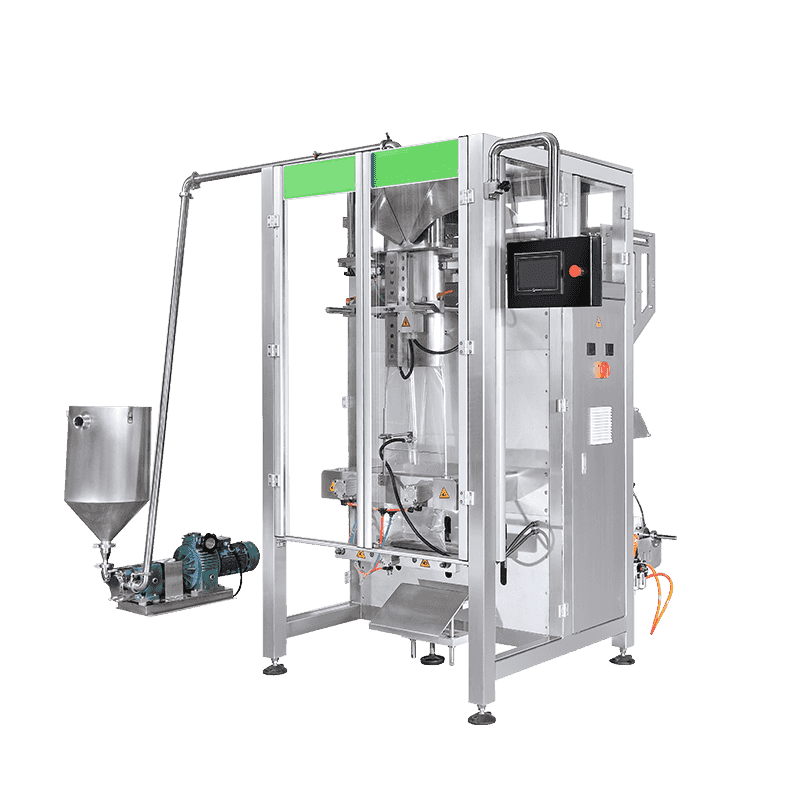
Pump fillers add a mechanical pump to the product pathway, giving them the ability to handle a much wider viscosity range than gravity or overflow machines. The pump type is selected to match the product: gear pumps for moderately viscous liquids like oils and syrups, peristaltic pumps for aggressive chemicals or products requiring sanitary, no-contact fluid handling, lobe pumps for products with particulates, and progressive cavity pumps for pastes and very thick materials. By matching pump type and speed to the product, pump fillers deliver accurate volumetric fills across thin-to-highly-viscous product ranges.
Pump fillers are the most flexible liquid filling option available and are widely used in food and beverage production (sauces, dressings, syrups), personal care products (shampoo, conditioner, liquid soap), household chemicals, and agricultural products. The trade-off versus gravity fillers is higher initial cost and more components requiring regular inspection and maintenance.
Piston Filling Machines
Piston fillers are the benchmark for accuracy with high-viscosity products. The machine draws product into a cylinder by retracting the piston, then pushes a precisely controlled volume into the container by advancing the piston. The same volume fills the cylinder with every cycle, resulting in highly accurate, repeatable fills — premium piston fillers achieve fill tolerances of ±0.5% or better. The wide-bore cylinder design also allows products with particulates — chunks of fruit in jam, herb pieces in sauce, or granules in paste — to pass through without clogging, provided appropriate valve types are used.
Piston filling machines handle the full viscosity spectrum from thin liquids up to stiff pastes like peanut butter, honey, thick ointments, and heavy creams. They are common in food production, cosmetics, pharmaceuticals, and specialty chemical filling. The machine is mechanically more complex than a gravity filler, requires more skill to set up correctly, and takes longer to clean between product changeovers — factors worth weighing against the accuracy and versatility benefits.
Liquid Filling Machine Types Compared at a Glance
The table below summarizes the key characteristics of each filling machine type to help narrow down options based on product and production requirements.
Comparison of the four main liquid filling machine types
| Machine Type |
Filling Principle |
Viscosity Range |
Typical Accuracy |
Best For |
| Gravity Filler |
Volumetric (timed flow) |
Low (thin, free-flowing) |
±1–2% |
Water, juices, oils, alcohol |
| Overflow Filler |
Level-based |
Low to Medium |
Consistent fill level |
Clear containers, cleaners, mouthwash |
| Pump Filler |
Volumetric (pump displacement) |
Low to High |
±0.5–1% |
Sauces, soaps, chemicals, syrups |
| Piston Filler |
Volumetric (positive displacement) |
Low to Very High |
±0.5% or better |
Pastes, creams, products with chunks |
Manual, Semi-Automatic, and Fully Automatic Configurations
Beyond the filling mechanism, liquid filling machines are categorized by their automation level. The right level of automation depends on production volume, labor availability, and budget — not every operation needs a fully automated line.
Manual Liquid Filling Machines
Manual fillers require no electricity or pneumatic power — the operator positions the container, triggers the fill by hand, and moves to the next container. They are appropriate for very low-volume production, start-up operations testing product formulations, or specialty batches where flexibility outweighs speed. Output is limited by operator pace, typically 5–20 containers per minute depending on fill size. Manual machines have the lowest capital cost and require no technical maintenance, making them a common entry point for small businesses and craft producers.
Semi-Automatic Liquid Filling Machines
Semi-automatic filling machines handle the fill cycle automatically once the operator positions the container and initiates the cycle — via foot pedal, hand trigger, or proximity sensor. The operator loads and unloads containers; the machine controls fill volume, timing, and nozzle actuation. Semi-automatic machines are well-suited to small-to-medium batch production, frequent product changeovers, and operations that handle multiple container sizes without the capital investment of a fully automated line. Output ranges from roughly 20 to 200 containers per minute depending on machine configuration, number of fill heads, and fill volume.
Fully Automatic Liquid Filling Machines
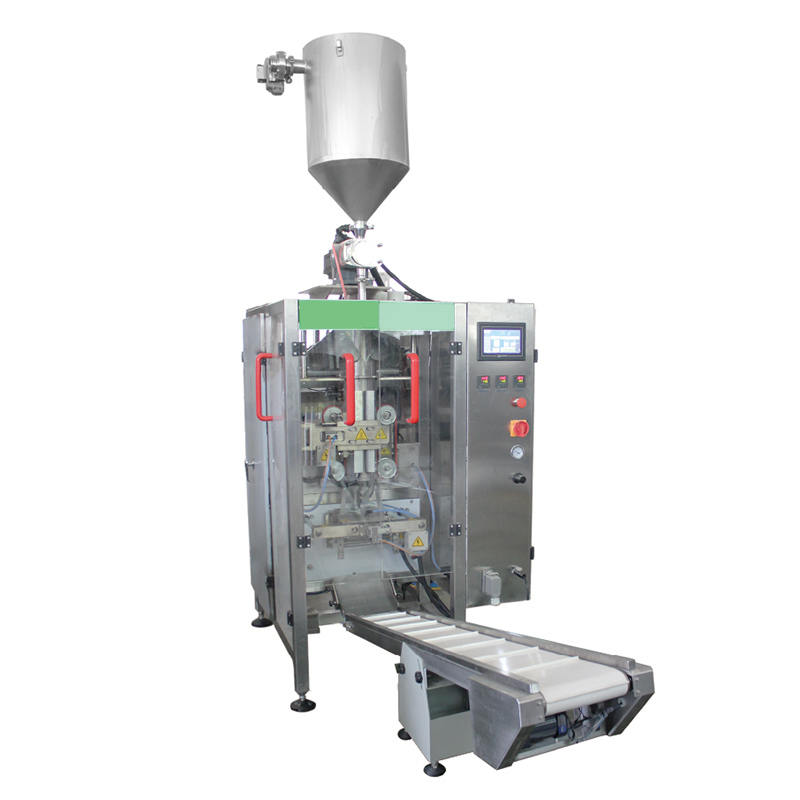
Automatic liquid filling machines integrate container conveyance, indexing, filling, and often capping and labeling into a continuous, operator-independent process. Containers feed in from one end, travel through the fill station, and exit filled and ready for the next packaging step. Fully automatic systems are standard in high-volume food and beverage, pharmaceutical, and consumer goods production. Line speeds for automatic fillers range from a few hundred to several thousand containers per hour depending on the machine design, number of fill heads, and product. Servo-driven automatic piston fillers can achieve fill accuracy of ±0.5% at sustained high throughput — levels that manual or semi-automatic operation cannot consistently maintain.
For operations producing fewer than 2,000 bottles per day, a fully automatic system is generally difficult to justify on economics alone. Semi-automatic equipment offers a practical middle ground: it scales with production growth, can be upgraded with additional fill heads, and doesn't require the facility infrastructure (conveyors, container handling systems, dedicated operators) that automatic lines demand.
Industry Applications: Which Sectors Use Which Machines
Liquid filling machines serve virtually every industry that packages liquid products. The specific machine requirements vary significantly by industry due to regulatory demands, product characteristics, and container formats.
Food and Beverage
Food production uses all four major filling machine types depending on product viscosity and container format. Thin beverages like water, juice, and wine use gravity or overflow fillers in high-speed automated lines. Carbonated beverages require counter-pressure isobaric filling machines that match the bottle's internal pressure to prevent CO₂ loss during filling. Sauces, dressings, and condiments of medium viscosity go to pump fillers; thick pastes, jams, and chunky salsas go to piston fillers. Food-contact liquid filling machines must be built in stainless steel (typically 304 or 316L grade) and designed for clean-in-place (CIP) or easy disassembly to meet food safety standards.
Pharmaceuticals and Nutraceuticals
Pharmaceutical liquid filling machines face the strictest requirements of any sector — accuracy, sterility, and full documentation of fill volumes are non-negotiable. Vial filling machines for injectable products use volumetric piston systems with diving nozzles that fill from the bottom up to minimize foaming and oxidation. Prefilled syringe filling machines draw liquid into syringes via automated pumps with precision metering. Pharmaceutical liquid filling equipment must comply with GMP (Good Manufacturing Practice) standards, FDA regulations in the US, or equivalent international frameworks, and materials in contact with the product must be validated for the specific drug formulation.
Cosmetics and Personal Care
Shampoo, conditioner, body wash, lotions, and serums span a wide viscosity range, which is why the cosmetics industry uses both pump fillers (for low-to-medium viscosity products) and piston fillers (for thick creams and heavy gels). Overflow fillers are popular for clear-bottled products where a consistent visual fill line matters for retail presentation. Cosmetic filling machines often need to handle fragrance-containing products, which can degrade certain pump materials — wetted parts material selection (316L stainless steel, PTFE, or specific elastomers) is a primary consideration in machine specification.
Chemicals and Industrial Products
Industrial chemical filling covers a vast range from thin solvents and acids to thick adhesives and lubricants. Chemical liquid filling machines must be specified with materials compatible with the specific chemical being filled — many aggressive chemicals attack standard stainless steel, requiring titanium, HDPE, or specialty-lined components. Explosion-proof electrical systems are required when filling flammable solvents. Drum and IBC (intermediate bulk container) filling machines are used for bulk chemical products, while smaller bottle filling machines handle retail and industrial service packaging.
Key Specifications to Evaluate When Buying a Liquid Filling Machine
Machine brochures list dozens of specifications. These are the ones that actually determine whether a machine fits your production needs — and whether it will still fit five years from now.
- Viscosity range: The single most important technical specification. Confirm the machine's documented viscosity range against your product's actual viscosity, measured in centipoise (cP) or millipascal-seconds (mPa·s). Water is 1 cP; honey ranges from 2,000 to 10,000 cP; peanut butter is 150,000–250,000 cP. Buying a gravity filler for a product that falls outside its viscosity range is a common and costly mistake.
- Fill volume range: The machine must cover both your minimum and maximum fill volumes. Confirm that adjustment between fill sizes is straightforward — ideally tool-free or menu-driven on CNC/servo machines — and that accuracy is maintained across the full volume range, not just at the nominal spec volume.
- Number of fill heads: More fill heads mean higher output per cycle. A 4-head semi-automatic machine fills four containers simultaneously; a 12-head automatic machine fills twelve per index. More heads also increase the machine footprint and cost, and require more frequent calibration checks to ensure all heads dispense equally.
- Fill accuracy: Expressed as a percentage or as an absolute volume tolerance. Premium volumetric machines achieve ±0.5%; gravity and timed-flow machines typically achieve ±1–2%. Match the accuracy requirement to the product — pharmaceutical and food volume-declared products require tighter tolerances than industrial lubricants.
- Output speed (bottles per minute or hour): Calculate your required output based on your production schedule, not your peak demand. Specify a machine that runs at 70–80% of maximum rated speed to maintain accuracy and reduce wear — running any filling machine at maximum rated capacity continuously accelerates maintenance needs.
- Container compatibility: Verify that the machine handles your current container range in height, diameter, and base configuration. Assess how quickly and easily the machine changes over between container formats — in multi-SKU operations, changeover time can significantly impact effective daily throughput.
- Cleaning and sanitation: For food, pharmaceutical, and cosmetic applications, CIP (Clean-in-Place) capability — where cleaning fluids can be circulated through the machine without disassembly — dramatically reduces downtime between product changeovers. Ask specifically how long a full product changeover and clean takes under normal operating conditions.
- Wetted materials: All components in contact with the product must be compatible with the specific liquid being filled. Standard food-grade machines use 304 or 316L stainless steel for product-contact parts. Chemical-filling machines may require PVDF, PTFE, or Hastelloy for aggressive products. Verify wetted part material specifications against your product's chemical properties before purchase.
Matching Filling Machine Type to Product Viscosity
Viscosity is the starting filter for any liquid filling machine selection. The table below maps product types to recommended machine configurations based on viscosity categories.
Viscosity-based liquid filling machine selection guide
| Viscosity Category |
Approximate Range (cP) |
Example Products |
Recommended Filler Type |
| Very Low (Thin) |
1–50 cP |
Water, alcohol, vinegar, thin juices |
Gravity filler, Overflow filler |
| Low to Medium |
50–500 cP |
Milk, light oils, mouthwash, wine |
Gravity filler, Overflow filler, Pump filler |
| Medium |
500–5,000 cP |
Shampoo, conditioner, sauces, ketchup |
Pump filler, Piston filler |
| High |
5,000–50,000 cP |
Honey, thick creams, heavy gels, motor oil |
Piston filler, Heavy-duty pump filler |
| Very High (Paste) |
50,000+ cP |
Peanut butter, silicone sealant, dense ointments |
Piston filler (heavy-duty), Auger filler |
Common Problems and How to Avoid Them
Even a correctly specified liquid filling machine will underperform if setup, maintenance, and process control are not managed properly. These are the most common issues and their root causes.
Inconsistent Fill Volumes
Variable fill volumes are most often caused by air in the product pathway, inconsistent supply pressure or tank level (for gravity and overflow fillers), worn piston seals or pump components, or product viscosity variation between batches. Establishing a regular seal and component inspection schedule, maintaining consistent product temperature (viscosity changes with temperature), and ensuring the supply tank stays at a consistent level addresses most fill inconsistency issues. For gravity fillers specifically, adding a constant-level tank in the supply system eliminates head pressure variation as a fill accuracy variable.
Foaming During Filling
Foaming is most common with detergents, shampoos, and other surfactant-containing products, and with carbonated beverages. Solutions include reducing fill speed, using bottom-up filling (where the nozzle dives to the container base and retracts as the liquid rises), incorporating a suck-back function to relieve nozzle tip pressure after each fill cycle, and keeping product temperature low to reduce dissolved gas release. Counter-pressure isobaric filling machines are the engineering solution for carbonated beverages, equalizing container pressure with the fill head before filling begins.
Dripping After Fill Cycle
Post-fill drip wastes product, contaminates container exteriors, and creates label adhesion problems. The primary solutions are suck-back (a brief reverse action that draws a small volume back into the nozzle after the fill valve closes) and nozzle tip design — dive nozzles and anti-drip valves significantly reduce residual drip on low-viscosity products. Regular inspection and replacement of nozzle tip seals and valve seats is essential maintenance on any filling machine running thin or medium-viscosity products.
Product Compatibility and Corrosion
Corrosive chemicals, acidic food products, and high-alcohol formulations can attack wetted parts that are specified for standard food or water service. Always run a chemical compatibility check — most pump and filler manufacturers publish material compatibility charts — and specify upgraded wetted part materials when filling anything outside the standard food and water category. Catching a compatibility issue before machine purchase is far less expensive than replacing corroded pump bodies and nozzles after six months of production.
Maintenance Checklist to Keep Filling Machines Running Accurately
Liquid filling machines are precision equipment. A consistent maintenance program is the difference between a machine that holds ±0.5% accuracy for ten years and one that drifts out of spec within months.
- Inspect and replace nozzle tip seals, O-rings, and gaskets on a scheduled interval — daily checks during high-volume runs, weekly on lower-throughput operations
- Calibrate fill volumes at the start of each production run by checking the first ten fills against target weight on a calibrated scale; readjust before beginning full production
- Clean and flush the product pathway completely after each production run; never leave product sitting in the machine overnight, especially with food, pharmaceutical, or reactive chemical products
- For piston fillers, inspect piston seal condition monthly and replace before seals reach the point of failure — a leaking piston seal creates fill volume errors that are difficult to diagnose without disassembly
- For pump fillers, check pump wear plates, gears, and rotor clearances per manufacturer schedule; worn pump internals cause fill volume drift and reduced output consistency
- Lubricate all moving parts — drive mechanisms, nozzle actuation linkages, and conveyor systems — per the manufacturer's lubrication schedule, using only food-grade lubricants where applicable
- Document fill accuracy data from calibration checks at the start of each run; tracking trends over time allows you to identify wear patterns before they cause production problems


 English
 Español
 عربى
عربى


Contact Us